
The U.S. 1000 dollar bill is real, but the government no longer issues it. Common small-size examples feature Grover Cleveland. Collector value depends on the exact series, issuing district, condition and rarity; the $1,000 denomination is not a market appraisal.
Learn the framework for U.S. coin dates, varieties and condition.
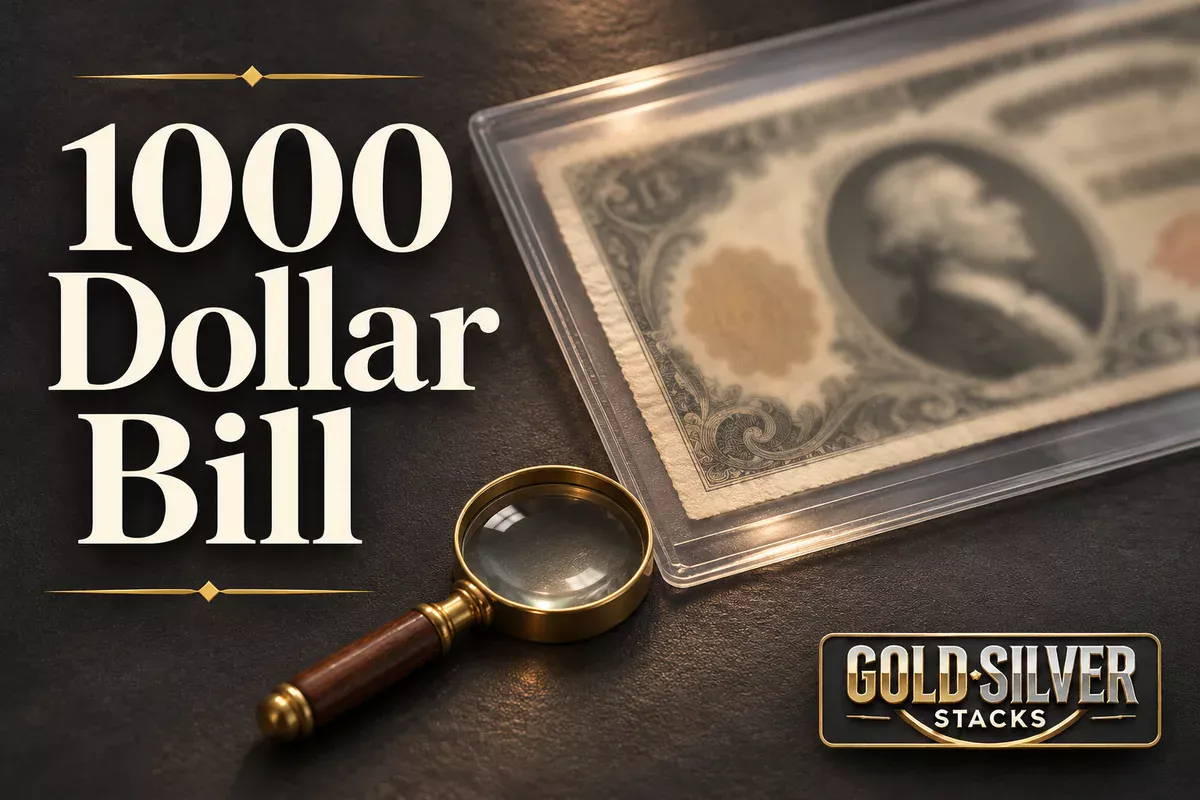
When did the government stop issuing $1,000 bills?
The Federal Reserve and Treasury discontinued the $1,000 denomination on July 14, 1969, along with $500, $5,000 and $10,000 notes. The Federal Reserve says these high denominations were last printed in 1945. Printing and issuance are different events, which explains the two dates.
The number in a note’s series designation is a separate identification detail. Do not treat “Series 1934” as evidence that the note was printed on a particular day in 1934.
Who is on a $1,000 bill?
Grover Cleveland appears on the familiar small-size 1928 and 1934-era Federal Reserve Notes. The PMG entry for the 1934 issue identifies Cleveland’s portrait. Older large-size $1,000 types are a different field and should not be priced as the same note.
Find more coin and physical-metal education at GoldSilverStacks.
The Smithsonian’s 1934 specimen provides a museum reference for the design. Compare the type and layout; a web image comparison cannot authenticate paper, printing or alterations.
How much is a $1,000 bill worth?
A genuine collectible example can sell above face value, but a useful valuation needs more than the denomination. As one documented comparison, GreatCollections reports $3,825 for a 1934 Chicago light-green-seal note graded PMG Very Fine 25. That is one sale for one identified note, not a price for every $1,000 bill.
| Detail to record | Why it changes the comparison |
|---|---|
| Series and note type | Different issues have different supply and demand |
| Federal Reserve district and seal variety | The matching catalog entry can differ |
| Numerical grade and paper-quality comments | Folds, repairs and original paper affect desirability |
| Serial number or star status | Special characteristics need exact attribution |
For each comparison, record the sale date and whether the reported total includes buyer’s premium. Then account for the seller’s commission and other selling costs. A retail listing, auction total and net payment to a seller are three different numbers.
Can you obtain a $1,000 bill from a bank?
A current banknote order cannot supply a newly issued $1,000 note because the denomination is discontinued. Collector purchases usually require a specialist dealer or auction comparison.
If you already own one, establish its collector value before using it in an ordinary transaction. Record both sides in clear photographs and seek an examination from a qualified currency specialist. Do not flatten it with an iron, wash it or repair a tear to improve its appearance.
What should you check before buying one?
Check the seller, the exact note and the return terms before the price. For a certified note, verify the certification number with the grading service and compare the holder’s details with the actual note. A matching number is one check; it does not substitute for examining the item.
Ask for clear photographs, paper-condition disclosures, delivery insurance and the total payment including fees. Our silver certificate guide explains another paper-money category; a silver certificate and a Federal Reserve Note should not share a valuation merely because both are old banknotes.
GoldSilverStacks covers physical metals and U.S. collectibles. For a high-denomination banknote, pair general collecting knowledge with note-specific authentication and current completed-sale evidence.
Learn the framework for U.S. coin dates, varieties and condition.
