
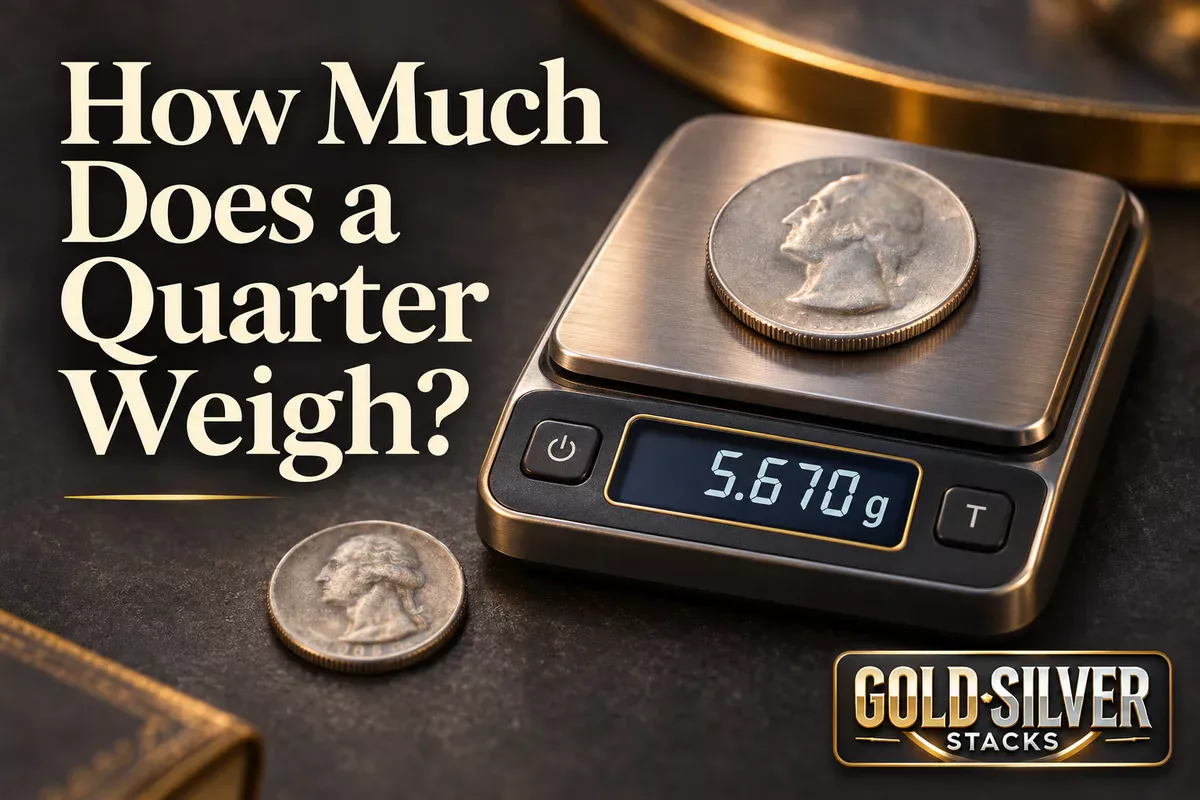
A standard copper-nickel clad U.S. quarter weighs 5.670 grams when new. A 90% silver Washington quarter dated 1932–1964 has a nominal weight of 6.25 grams. Identify the issue before comparing a scale reading with either number.
Learn the framework for U.S. coin dates, varieties and condition.
What is the weight of an ordinary U.S. quarter?
An ordinary modern clad quarter has a nominal weight of 5.670 grams, a diameter of 24.26 millimeters and a reeded edge. The U.S. Mint lists its circulating-coin specifications.
“Nominal” means the specified production weight. It does not mean every used coin will read exactly 5.670 on a household scale. Wear, attached dirt, scale accuracy and normal manufacturing variation can affect a measurement.
How much do silver quarters weigh?
Silver-quarter weight depends on the issue. Do not use a single silver-quarter figure for every collector version.
Find more coin and physical-metal education at GoldSilverStacks.
| Quarter type | Nominal weight | Metal distinction |
|---|---|---|
| Ordinary clad quarter | 5.670 g | Copper-nickel clad |
| 1932–1964 Washington quarter | 6.25 g | 90% silver |
| 1976-S silver collector quarter | 5.75 g | 40% silver clad |
Later silver proofs need their own product specifications. The small difference between a 5.75-gram silver Bicentennial and a 5.670-gram clad coin is just 0.08 gram. A coarse kitchen scale cannot reliably resolve that distinction.
How much does $10 in quarters weigh?
Forty ordinary clad quarters have a nominal combined weight of 226.8 grams: 40 × 5.670 = 226.8. That is the coins alone, before a wrapper or container.
| Clad quarters | Face value | Calculated coin weight |
|---|---|---|
| 4 | $1 | 22.68 g |
| 40 | $10 | 226.8 g |
| 400 | $100 | 2,268 g |
Those calculations assume every coin is the same clad type. A mixed group of silver and clad quarters will not follow the table exactly. Use the junk silver guide when the metal composition is the question.
Does an unusual weight mean a rare error?
An unusual weight is a reason to investigate, not an error diagnosis. First repeat the reading on a calibrated scale, confirm the unit is grams and remove the holder’s weight from the calculation.
Then compare the date, diameter, edge and design with the correct issue. Wear, damage, foreign coins, replicas and attached material can all complicate identification. A wrong-planchet claim needs more evidence than a single number. The error identification guide explains what to document.
How should you photograph and record a questionable quarter?
Record the coin’s date, mint mark, repeated weight readings and scale resolution. Photograph the two faces and the edge without filters. Keep it untreated in a suitable holder.
A useful description is specific: “1965 quarter, repeated readings near 6.2 grams on a calibrated 0.01-gram scale,” rather than “rare silver error.” An expert can test that observation against the actual coin. The coin errors hub is the next reference for a plausible minting anomaly.
Learn the framework for U.S. coin dates, varieties and condition.
